Technology
How Agricultural Robots Are Revolutionizing Harvesting Efficiency

 Add MyCannabis.com to your preferred sources on Google

As global labor shortages and agricultural demands increase, the race to automate harvesting tasks has never been more urgent. Researchers are now making significant strides in creating intelligent robots that not only mimic human dexterity but also navigate complex and variable farming environments autonomously. A study1 published in Computers and Electronics in Agriculture showcases a major leap forward in this field, offering a glimpse into a future where autonomous robots could become indispensable tools in precision agriculture.
Key Advancements in Agricultural Robot Navigation
Led by Assistant Professor Takuya Fujinaga at Osaka Metropolitan University, the research introduced a novel algorithm that enables agricultural robots to navigate autonomously among high-bed cultivation fields using LiDAR technology. This remote sensing method—commonly found in self-driving cars—emits laser pulses to generate highly accurate 3D maps of the environment, enabling robots to move accurately without human guidance.
The robot demonstrated two key modes of movement:
- Point-to-point navigation, which guides it to specific locations across the field.
- Bed-following movement, which allows the robot to track alongside raised cultivation beds such as those used for strawberries or tomatoes.
This dual navigation ability enables the robot to maintain a consistent distance from plants, crucial for avoiding damage and optimizing harvesting performance. The robot’s effectiveness was confirmed in both virtual simulations and real-world testing environments.
Limitations and Future Development of Agricultural Robots
While the robot shows immense promise, several challenges remain. According to the study’s limitations, the current system lacks:
- Limited terrain adaptability reduces reliability in uneven or sloped fields.
- Obstacle recognition refinement is particularly important when unexpected objects enter the path.
- Multi-tasking ability, such as integrating pruning or disease detection alongside harvesting.
Moreover, the algorithm’s effectiveness under variable lighting and weather conditions must be tested further. These improvements are essential before these robots can be deployed at scale across diverse farming environments.
How Autonomous Farming Robots Will Shape Agriculture’s Future
The innovation coming out of Osaka Metropolitan University goes far beyond simply teaching a robot to pick fruit—it’s laying the groundwork for a new era of intelligent, adaptable agricultural tools that could redefine how we grow, manage, and harvest crops across industries. At the heart of this evolution is precision navigation. Once a robot can reliably traverse complex environments without human intervention, a whole new realm of capabilities opens up.
These autonomous systems could soon move beyond harvesting to tackle tasks like pruning, disease detection, crop monitoring, and even yield prediction. With the right sensors and machine learning models, a robot could visually assess plant health, adjust its behavior in real-time, and feed data into larger farm management systems. Think of it not just as a robotic harvester—but as a mobile, AI-powered agronomist that works tirelessly around the clock, revolutionizing the farming industry.
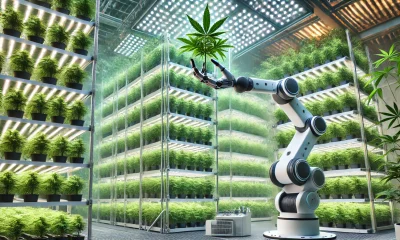
This shift is especially exciting for specialized and labor-intensive industries. In indoor and greenhouse cannabis cultivation, where space is tight and plant quality is everything, a precision robot could manage tight rows without disrupting airflow or damaging sensitive trichomes. It could potentially be trained to recognize the perfect time to harvest each bud, reducing waste and increasing consistency—an invaluable asset in a highly regulated, premium-quality industry.
Similarly, in viticulture, robots could monitor grapes from flowering to ripening, applying targeted treatments or harvesting only at peak maturity. In vertical farms, they could operate efficiently in stacked environments where human access is limited. Even ornamental plant nurseries—where aesthetics and delicacy are paramount—could benefit from robotic caretakers that reduce breakage and enhance uniformity. The opportunities are endless in agriculture once the robots are complete.
The technology can also potentially support sustainable farming techniques in the future. As these systems mature, farms may rely less on seasonal labor migration and more on year-round, automated support. This could help address chronic labor shortages while improving farm safety and reducing operational costs. In the future, robots equipped with solar-powered systems, advanced path planning, and AI decision-making could eventually contribute to more energy-efficient and climate-resilient farming practices.
Ultimately, what’s being developed now is not just a tool—it’s a platform. A foundation for the next generation of smart farming, where integrated robotics, data science, and environmental sensors work together to optimize everything from soil moisture to harvest timing. It’s a vision where farming is no longer a balancing act between scale and care, but a synchronized, intelligent process rooted in precision and sustainability.
The Future of Smart Farming and Agricultural Robotics
This breakthrough in robot navigation and harvesting from Osaka Metropolitan University marks a critical step toward fully autonomous agriculture. While current limitations must be addressed before large-scale deployment, the potential is immense, offering a sustainable, efficient, and scalable solution to modern farming challenges. Whether it’s strawberries or cannabis, the age of smart harvesting is growing fast, and the seeds of tomorrow’s agricultural revolution are already being planted.
Studies Referenced:
1. Fujinaga, T., Nishi, T., & Okamoto, H. (2024). Autonomous navigation system for agricultural robot using LiDAR and traversability cost map in high-bed fields. Computers and Electronics in Agriculture, 214, 108331. https://doi.org/10.1016/j.compag.2025.110001