News
How Automation Integrators Are Scaling Cannabis

 Add MyCannabis.com to your preferred sources on Google
The content on MyCannabis.com is for educational purposes only and should not be taken as medical advice.

Given the sheer size and manufacturing volumes that most large-scale cannabis facilities operate under, multi-faceted machinery that has many different functions and hundreds of added parts has become necessary. Whether those are machines that can sort and weigh different flower sizes up to ounces at a time, or labeling and sealing machines that look somewhat like Rube Goldberg machines, the types of complex machinery cannabis manufacturing facilities utilize are numerous.
However, to the disadvantage of cannabis manufacturers, it’s quite difficult to synchronize and integrate the diverse types of machines into a cohesive unit for a wide variety of technological and engineering reasons. Such professionals, knowledgeable in syncing all the cannabis processing systems, weren’t widely utilized or even really existed -until recently, that is.
Current Issues in Cannabis Manufacturing Automation
Because of the different types of machinery being utilized, the dysfunction and lack of synchronicity between the machines, and the incompatibilities between the technologies, can cause huge roadblocks in the very timely manufacturing processes, which quickly compound when they’re delayed. When there are this many hiccups in the production process, the ramifications and ripple effects can be costly and stretch across the entire business.
“I would assume that probably efficiencies and overall revenue optimization has been curtailed by at least 30%, if not more.” recalled Nohtal Partansky, Co-Founder and CEO of Sorting Robotics. “Just given the amount of inefficiencies that I’ve seen, it’s probably closer to 50%, but I think 30% is an easy guess, and it wouldn’t take that much convincing to get other people to agree to that number.”
What Is a Cannabis Systems Integrator?
With the increasing use of automation in cannabis, given how quickly the industry is growing, there have been quite experienced teams and companies formed with the sole purpose of achieving symmetry and creating the desired synchronicity between manufacturing machines in America’s newest industry.
“In simple terms, an integrator is a company that designs and builds automation systems for manufacturers who aren’t automation experts themselves. It’s a very common role in industries like pharmaceuticals, food, and automotive, but relatively new in cannabis. Different brands use different communication protocols, control software, and hardware standards. The integrator’s job is to make all those pieces talk to each other like a coordinated orchestra rather than a bunch of soloists.
Take pharma, for example. A pharmaceutical company’s core competency is developing drugs, not building robots or automation systems. They need precision and control in manufacturing, but they don’t need teams of robotics PhDs or electrical engineers on staff. Instead, they bring in an integrator, essentially a full-service automation consultant, to design and implement the systems that make their products efficiently and consistently.”
Partansky further explained that the duties of an integrator, or integrator team, go far beyond simply ensuring that all the machines are running efficiently together and none are malfunctioning. In fact, those duties include everything from studying current manufacturing processes to building from very intricate machinery designs.
“If you’re a cheese manufacturer who needs to package 100,000 cubes a day, you’d call an integrator to build a line that does exactly that. They’d design it, build it, test it, and install it in your facility, then maintain it under a service contract. This is how most manufacturing is done worldwide, integrators make automation accessible.”
How Integrators Improve Cannabis Production Efficiency
Because efficient manufacturing is everything in the cannabis industry, and large production quotas and deadlines have to be met or else there will be hell to pay, integrator teams have proven incredibly useful in numerous ways, boosting the necessary efficiency standards. Along with working with a robust, experienced team of integrators, having fully automated systems can lead to even greater operational benefits and insights, such as gathering valuable manufacturing data and making real-time adjustments.
“True efficiency comes from smarter coordination, not just faster machines. When every part of production is linked, you can track downtime, predict maintenance needs, and continuously refine performance. For cannabis manufacturers, that means smaller teams can produce more with better consistency and less waste.
In modern systems, this goes beyond just wiring machines together. Integrators are layering in data collection, vision systems, and even AI models to monitor performance in real time.”
| Challenge | Without Integrator | With Integrator |
|---|---|---|
| Machine Communication | Disconnected systems | Unified control architecture |
| Downtime Tracking | Manual logging | Real-time analytics |
| Quality Control | Human inspection | Machine vision & AI monitoring |
| Scalability | Incremental expansion | Modular automation design |
The Future of Automation in Cannabis Cultivation and Processing
It’s understandable to see how these integrator teams could help exponentially increase manufacturing operations and subsequent production output, and Partansky predicts they’ll become even more widely used as the industry expands. In fact, Partansky sees integrator teams as an opportunity for the cannabis industry and operations to raise their manufacturing standards to the level of far more established, federally legal industries.
“Integrator technology has the potential to completely reshape large-scale cannabis manufacturing by bringing the same level of precision, consistency, and throughput found in established industries like food and pharmaceuticals. Right now, many cannabis operations still rely on manual labor and disconnected equipment. Automation changes that by standardizing every step of production, from filling and packaging to quality control, so products are uniform and scalable.”
Interestingly, Partansky mentioned how cannabis manufacturing and post-harvest duties, such as packaging, aren’t the only departments of a cultivation facility that could receive great benefit from working with integrator teams.
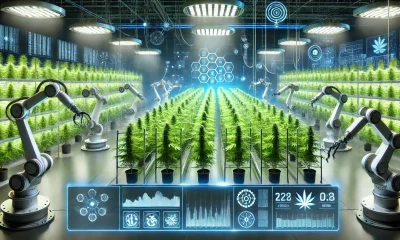
“This approach can also extend to cultivation. The same principles of automation and data integration can optimize growing conditions, irrigation, nutrient delivery, and harvest timing. With the right systems in place, cultivation could become as measurable and predictable as any modern agricultural process, transforming cannabis from an artisanal crop into a fully industrialized product category.”