Interviews
Nohtal Partansky, Founder and CEO of Sorting Robotics – Interview Series

 Add MyCannabis.com to your preferred sources on Google

Despite the diverse and impressive group of previous industries that many established cannabis professionals and business owners previously worked in, very few of those people can say that NASA previously employed them. Yet for Nohtal Partansky, Founder and CEO of Sorting Robotics, this is very much the case. From serving as lead engineer for the Mars Oxygen In-Situ Resource Utilization Experiment (MOXIE) system to designing robotic machines to assist in cannabis manufacturing and processing, Partansky’s educational and professional journey is quite fascinating.
What engineering fields did you study while attending the Georgia Institute of Technology, and what is the overall importance of those subjects?
I got a Masters Degree in Aerospace Engineering so I studied Fluid Mechanics, Multidisciplinary Design Optimization, Electric Propulsion, Robotics, Numerical methods, Partial Differential equations, Aircraft Design, Rocket Design, and a bunch of other related fields. All of these were incredibly useful in helping me become an engineer that could tackle complex problems I was faced with solving during my time at NASA-JPL, and currently in the cannabis industry.
What initially interested you about studying and eventually working in those fields?
I’ve always been interested in flying and spacecraft. When I was in junior high I was flying model airplanes as a hobby. I enjoyed the act of building them and eventually flying them; I never really did many competitions for hobby aircraft but I found it incredibly relaxing. When I did undergrad, I initially was a biochemical engineering major, however, it was only a few months that I became envious of my other friends doing mechanical and aerospace engineering. After my first year I switched into a mechanical and aerospace engineering double major so I could be more hands on and follow my passion for understanding how things fly and flow through the air.
What were your regular duties as an Undergraduate Researcher at UC Davis and a Graduate Research Assistant at Georgia Institute of Technology?
When I did research as an undergrad I mostly worked in the fuel cell laboratory understanding lifetime cycles for cathodes. It wasn’t the most interesting work in the world, but I spent a year creating a lifetime test for a company who has a fuel cell in caustic environments. I did most of the building and the grad student who was leading the project did most of the programming for the experiment set up.
In Georgia Tech, my research was focused on creating software models for multidimensional optimization programs. I used some open source python libraries to explore different algorithms that can visualize what’s called a “pareto frontier” of optimized variables. Then my software would visualize the optimization in many different dimensions with correlated and uncorrelated variables.
So I’m pretty sure that you’re the first cannabis ancillary business owner I’ve interviewed who has previously worked for NASA. What positions did you hold with the prestigious organization, and how would you describe the great importance of your work with NASA? What is the M2020 Mission?
When I was at the Jet Propulsion Laboratory, I worked on a system called MOXIE, which stood for Mars Oxygen In-Situ Resource Utilization Experiment. This project was meant to demonstrate that a human made machine on the surface of Mars could use the atmosphere of Mars to generate oxygen. This generation of oxygen is critical for the creation of breathable air and then also as a fuel for rockets. So if you’re going to do a return mission from Mars, you don’t want to bring the fuel with you that you need to return from Mars. You want to create the fuel there and then use that to take you back home.
The M2020 mission is the Perseverance rover. At NASA, the missions don’t have cool names until usually a year or two before it actually launches. So M2020 stood for Mars 2020, which was the year that it was launched to Mars. So M2020 is just a rover that holds a lot of experiments. It’s a robotic system controlled from Earth that walks around Mars, or I guess rolls around Mars, exploring the surface. Currently, all the cool pictures that you see from the Martian surface are being taken from the cameras on the M2020, or what’s now called the Perseverance rover.
How did you create Roca Robotics, and how does the Roca Sorter assist with inventory matters and concerns within the trading card market?
I created the Roca Sorter system when I paired up with my co-founders of Sorting Robotics. I knew that this system was really important to create because I had played Magic the Gathering professionally when I was in high school and college, and sorting cards was such a pain in the ass for me. I had friends who owned trading card stores, sold online, and when I came back from graduate school, I knew that this was something that was needed in the market. I just needed a good team to build it. Three years later, I found my co-founders for Sorting Robotics.
Currently, the Roca Sorter is deployed in five different continents, and the technology is owned by eBay that owns a subsidiary called TCG Player that runs their trading card division. At the moment, it sorts and does fulfillment for eBay’s trading card division, and then it does the same thing for small business owners all over the world by sorting through their Magic the Gathering cards, Pokemon cards, and Yu-Gi-Oh cards.
What were some defining moments that led to the founding of Sorting Robotics? Also, did you initially have some concerns or reservations about developing technology for the cannabis industry?
The defining moments that led to the founding of Sorting Robotics was really the desire to build the Roca Sorter. It wasn’t until we commercialized the Roca Sorter that we noticed that the market it was serving was very small and would never allow us to build a very large company. So, we joined Y Combinator and that was a defining moment for Sorting Robotics. This allowed us to expand our network and do customer development at a scale that we didn’t have access to before. That was when we started to get into the cannabis industry and when we made the decision to move away from trading cards and pivot into cannabis manufacturing robotics.
Originally, we didn’t have any concerns about developing technology for the cannabis industry because we moved into the market in 2019 and this was just a year after cannabis was legal in California. There was so much momentum with cannabis starting with Washington, Colorado, and Oregon, then California, Nevada, and everyone really thought that cannabis was going to become federally legal within a few years. When we got into cannabis, we just saw it as the timing being perfect. We didn’t know that the industry was going to have so many troubles as it has had in the past few years and that federal legalization would come to a near stall, which is what it looks like right now. We wanted to help people that were trying to bring this market into the commercialized public and fill a gap that no one else was fulfilling.
What services and needs does the machinery fulfill within the cannabis cultivation and post-harvest (trimming and packaging) cycle?
Our technologies focus on the manufacturing of end products. Our current focus is mostly in cannabis pre-rolls, specifically in infused pre-roll automation. Our first product that we launched in 2021 in this sector was the Jiko robot that creates infused hash holes. We pioneered the technology to create injection style joints. That was something that I developed with my team back in 2020, and we first sold the Jiko back in 2021. Now, here we are in 2025, and the “injection style” joint is its own SKU that can be found all over US and Canada. While we’ve seen a few copycat machines out in the wild, we’re still the market leader, and we continue paving the way for internal infusion technology development.
The next product that we started shipping last year was Stardust, which is a device that’s used to kief coat joints with either glue or distillate. It’s the first of its kind, and currently the only device on the market that has that capability. We’ve also done a bunch of other projects in pick/place for palletization of jars. We’ve built a vape cart filling system called the Omni-Filler. We also built a system that did biomass sortation by using computer vision to sort buds, stems, and leaves from dried cannabis trim. We even made an ERP system for hand trimming weed.
How do you envision robotics and automation impacting the aforementioned processes? Could Sorting Robotics machinery fulfill the duties of most employees in a cultivation/production facility, from cannabis cultivation specialist to packager?
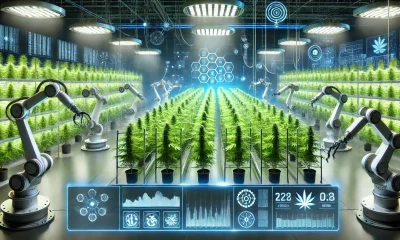
Robotics and automation significantly streamline cannabis cultivation and production processes by ensuring consistency, precision, and scalability. At Sorting Robotics, our technology doesn’t replace every human role but rather complements and enhances them. Our machinery efficiently handles repetitive, high-volume tasks such as preroll manufacturing and packaging, freeing employees to focus on specialized roles like quality assurance and customer service. Full automation of every aspect, from cultivation specialist to packager, isn’t yet practical or optimal—human insight, judgment, and adaptability remain crucial, particularly in cultivation management and decision-making processes.
How would these machines/technologies improve safety in both the workforce and the workplace of cannabis production facilities?
Introducing robotics into cannabis production dramatically improves workplace safety by minimizing human interaction with potentially hazardous materials, repetitive tasks, and physically demanding activities. Automation reduces the risk of repetitive strain injuries, exposure to harmful substances, and errors caused by fatigue or distraction. Sorting Robotics machines also enhance cleanliness and reduce contamination risks for the end products; this way it makes every retail product that much more safe.
Do you have concerns that automation and these technologies will eventually entirely replace the regular roles of cultivation/production employees in these facilities?
While robotics will increasingly automate routine, repetitive tasks, I don’t foresee complete replacement of cultivation or production roles. Instead, robotics will shift employment towards higher-value responsibilities that leverage human creativity, judgment, and innovation. Roles may evolve, emphasizing oversight, technology management, and strategic improvements rather than manual labor.
If we zoom out 25 years with the advancement of artificial general intelligence (AGI), I think most jobs in the world will be replaced with intelligent robotic systems. That isn’t a bad thing though. Do you remember the Jetsons? I think most people would rather live in a world where they have an abundance of resources and only need to work 4 hours per week.
As a career engineer and a successful entrepreneur as well, how do you see these machines/technologies improving and evolving as the industry itself evolves over the years?
I see immense potential for robotics and automation to continually evolve alongside the cannabis industry. Advances in AI, machine learning, and foundational robotics models will enable Sorting Robotics machines to become increasingly versatile, adaptive, and efficient, seamlessly integrating into evolving production processes. As cannabis products diversify, automated systems will become even more precise, hygienic, and adaptable to specialized production needs, enabling operators to quickly respond to market trends and regulatory changes, ensuring sustained growth and competitiveness in a rapidly evolving industry.
Thank you for joining us, Nohtal! Please visit its website for more information on Sorting Robotics and its machinery.